Why Cardboard Now Costs GIRO Money to Recycle
For many years, cardboard quietly helped support recycling on Gabriola. When markets were stronger, the Gabriola Island Recycling Organization (GIRO) could sell our baled cardboard for a small amount per tonne (about $15). It wasn’t much, but it helped cover ferry fees, fuel, and the everyday costs of keeping the depot running.
Since 2023, that’s changed. Today, cardboard no longer brings in income — it actually costs GIRO money to recycle.
In 2024, GIRO paid about $5,500 to process the community’s cardboard and mixed paper. In 2025, that cost rose to almost $8,000. These are real dollars that now have to come from donations, sales, and community support — not from recycling markets like they once did.
And while this feels surprising here at home, it’s part of a much bigger story unfolding well beyond our island.
Cardboard as an economic indicator
Cardboard doesn’t just tell us something about recycling — it also tells us something about the economy.
Economists often look at cardboard and packaging as a quiet indicator of how much buying and selling is happening. When people are shopping more, more goods are shipped, and more cardboard boxes are used. When people tighten their belts, fewer products move, and less cardboard is created in the first place.
Right now, Canada is experiencing what many economists call a soft recession. People are spending more carefully because of higher living costs, interest rates, and general economic uncertainty. That means fewer online orders, fewer big purchases, and fewer boxes moving through the system.
With less cardboard being generated, there is less demand for recycled fibre, less activity in packaging production, and less value in the cardboard market. Even before cardboard reaches a recycling depot, its economic footing is already weaker — and that ripple is being felt all the way out here on Gabriola.
A global shift, felt on a small island
Recycled cardboard is part of a worldwide market. When demand is strong, recycling facilities are paid for the fibre they collect. When demand drops, that same material becomes something facilities must pay to move.
Over the past few years, fewer overseas buyers have been purchasing recycled paper fibre. At the same time, new cardboard made from fresh wood has become cheaper than recycled fibre. Packaging companies are under pressure to cut costs wherever they can.
The result? Cardboard that once helped support GIRO is now one more expense we must carry.
Why mill closures on Vancouver Island matter to us
For decades, pulp and paper mills on Vancouver Island and across British Columbia were important partners in the recycling system. They bought recycled fibre and turned it back into paper products.
But many of those mills have closed or scaled back. They’ve been squeezed by high energy and transportation costs, aging equipment that is expensive to upgrade, less access to affordable wood fibre, and low prices for pulp and paper products.
When sawmills close, it affects pulp mills too — because pulp mills rely on leftover wood chips from sawmills to stay viable. As more parts of the forest industry shut down, fewer buyers remain for recycled cardboard.
For a small place like Gabriola, that means our cardboard has to travel farther to find a buyer — and every extra kilometre adds cost.
The island reality: distance matters
On a small Gulf island, recycling isn’t just about sorting — it’s about island logistics.
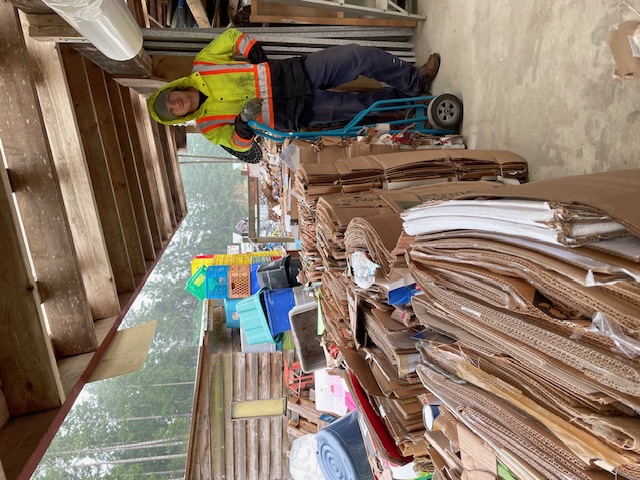
Every bundle of cardboard at GIRO must be sorted and baled, loaded and shipped off-island, and trucked to a processor. Fuel prices and ferry fees have all climbed. What once felt manageable now adds up quickly. Even before cardboard reaches a buyer, a lot of care — and cost — has already gone into getting it there.
When “free” recycling turns into a community service
For a long time, many of us believed recycling paid for itself. The truth is, it only worked that way when markets were strong.
Today, recycling looks more like other essential island services — these things don’t exist because they’re profitable. They exist because they matter.
GIRO continues to recycle cardboard not because it makes money, but because it keeps material out of landfill, reduces methane emissions, lowers the need to cut more trees, and supports the kind of caring, responsible community Gabriola has always been.
How islanders can help
Even when markets are tough, small actions make a big difference:
• Keep cardboard clean and dry — rain and food residue reduce its value.
• Instead of recycling it, try using cardboard in your garden — it’s great for keeping weeds down naturally.
• Flatten boxes to save space and handling time, and if you’re dealing with small volumes, place cardboard in your curbside bin.
• Reduce packaging by choosing reusable options.
• Support GIRO — through memberships, donations, and simply spreading the word that recycling still matters, even when it costs more.
The heart of it
Cardboard hasn’t lost its environmental value — it has lost its market value.
In just two years, GIRO went from earning a little on cardboard to paying thousands of dollars to keep cardboard and mixed paper out of landfill. We make that choice because protecting our island matters more than short-term economics.
On Gabriola, we’ve always understood that some things are worth doing even when they’re not easy or cheap. GIRO will continue recycling cardboard because caring for our island, our forests, and our future is part of our mandate.
Recycling is still worth doing.
It just isn’t free anymore — and that’s a story we now share together as a community.
Thank you for supporting GIRO!

About Post Author